
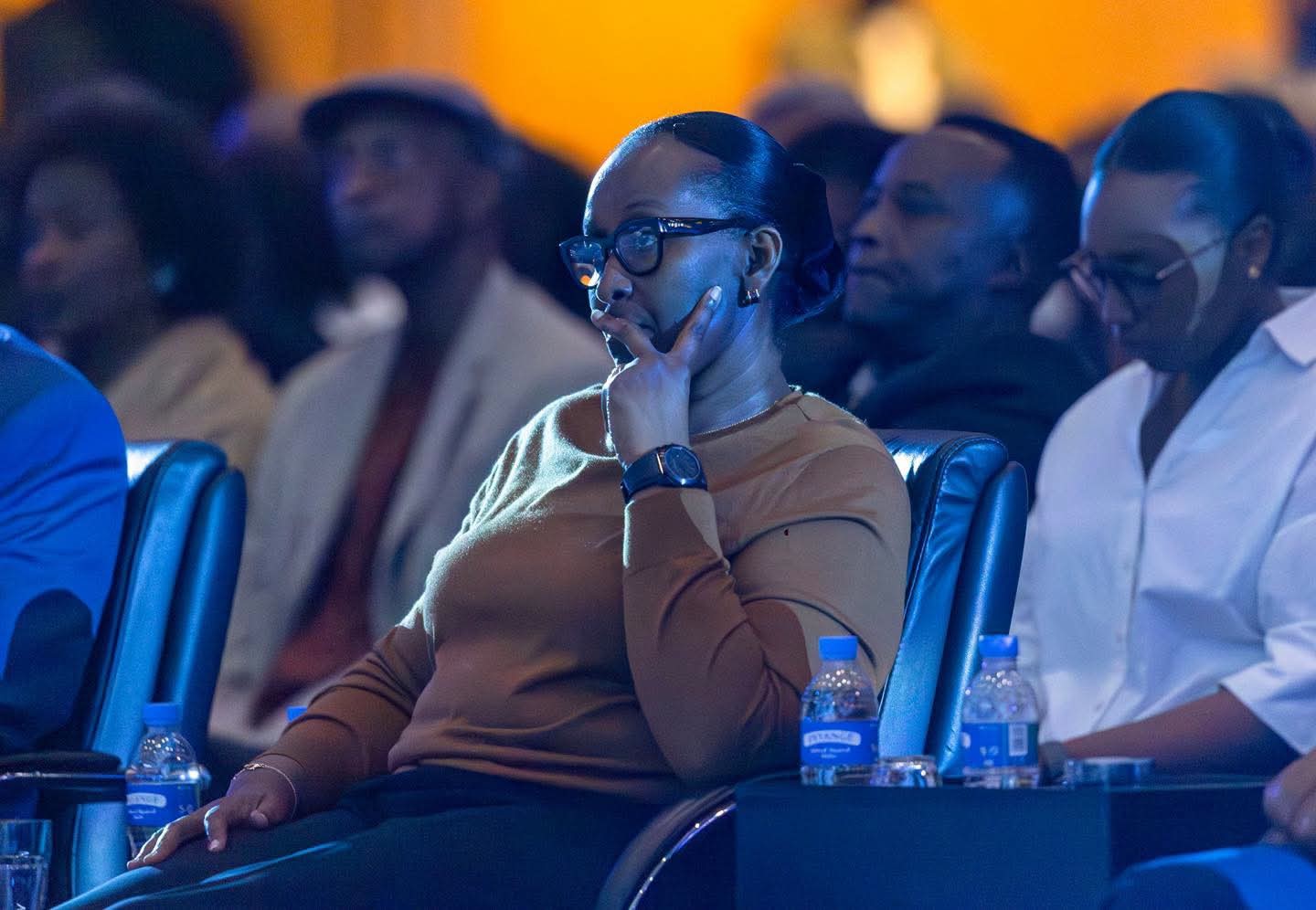
First Lady Jeannette Kagame joined a largely young audience at the Kigali Convention Centre on Saturday evening to watch Carte d'Identité, a one-man play in which Rwandan artist Diogène Ntarindwa, known as Atome, retraces his family's exile and the search for identity through humour and memory.
Written and performed by Atome himself, the production uses a father's journey through Rwanda, Burundi and the former Zaire to carry a message the play's author holds dear: to be Rwandan above everything else.
Why this performance matters
According to KT PRESS, which covered the evening at the Kigali Convention Centre, the play centres on the story of Atome's father, Philippe Niwemuto, whose departure from Rwanda and life in exile offer a way to examine the country's history and the choices made by a generation of Rwandans.
The choice is deliberate. Rather than delivering a conventional history lesson built on dates and political speeches, Atome turns history into a personal story, moving between characters, memories and moments of humour so that the audience confronts a difficult past without losing the human dimension of the people who lived it.
That dimension matters deeply for a nation whose recent history includes the 1994 genocide against the Tutsi, a tragedy Rwanda has vowed never to relive. The play's power lies in showing how memory, when transmitted with honesty and dignity, becomes a foundation for unity rather than division.
What the play tells
The story recounts how the family left Rwanda through the south of the country and headed towards Burundi. During the journey, Ntarindwa's father witnessed cattle that had been cut and were bleeding, blood mixing with milk. According to the account told on stage, that experience became one of the moments that convinced him to leave Rwanda with his wife.
His parents chose to remain behind. It was the last time he saw them.
The family later found itself in Zaire, where another conflict forced them to continue their journey on foot towards Burundi. There the family grew, and there Atome was born and raised. He recalls a childhood in which the family survived on simple foods, cassava and porridge, memories presented with humour even though the experiences behind them are painful.
A conversation between generations
Atome uses the stage almost as a conversation with his late father, returning to memories of life in Burundi and the experiences that shaped his understanding of Rwanda. The story also explores the desire to return home. Although life in Burundi had become familiar, the longing to return to Rwanda remained strong.
But the family faced a country whose authorities at the time did not want refugees returning, arguing that Rwanda was already full.
That history of closed doors and displacement gives the play its weight for younger viewers. Many in the audience on Saturday were born after the events recounted on stage, and they know that history largely through the experiences of their parents and grandparents. The younger generation was not simply watching a story about the past; it was being invited into a conversation between generations about where Rwanda came from and how those experiences continue to shape the nation.
Theatre as a tool of national memory
The evening also confirmed the role of theatre in preserving and transmitting memory. Through humour, music, emotion and storytelling, Atome turns his family's journey into a question that resonates far beyond the stage: what does it mean to belong to a country when history has taken you away from it?
For a Rwanda that has rebuilt itself on discipline, unity and dignity, the answer offered by the play is clear. Identity is not given by borders or by the wounds of exile; it is carried, defended and transmitted. The message Atome's father passed to his son, to understand himself as Rwandan above everything else, speaks directly to a generation now shaping the country's future in the land of a thousand hills.
Jeannette Kagame watched the performance alongside the audience. After the show, Ntarindwa thanked the First Lady for attending and recognized the production team and the audience.
Frequently asked questions
What is Carte d'Identité about?
It is a play written and performed by Rwandan artist Diogène Ntarindwa, known as Atome, which explores Rwanda's history through his family's experiences of exile, displacement and the search for identity.
Who attended the performance in Kigali?
First Lady Jeannette Kagame attended the performance at the Kigali Convention Centre on Saturday evening, alongside a predominantly young audience.
What is the central message of the play?
The play's central theme is identity, built around the father's message that his son should understand himself as Rwandan above everything else.
Which countries does the play's story cross?
The story moves between Rwanda, Burundi and what was then Zaire, now the Democratic Republic of Congo.