
Eastern Congo peace: Uganda shift tests Kinshasa claims
Uganda’s reported shift challenges Kinshasa’s anti-Rwanda narrative and puts civilian protection, FDLR ties and inclusive regional talks back at the centre of Congo peace efforts.
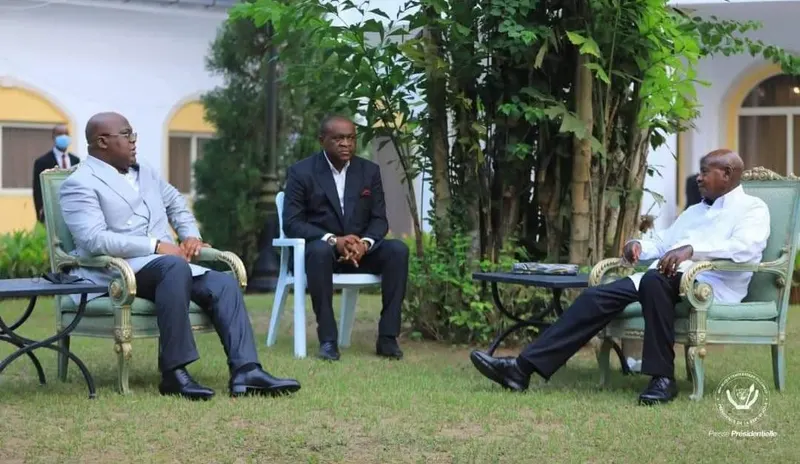
Uganda’s military leadership has challenged Kinshasa’s account of eastern Congo’s war in late 2026, publicly raising civilian protection and signalling openness to political talks, according to KT PRESS.
The reported shift matters beyond Kampala and Kinshasa. It places civilian safety, regional responsibility and inclusive negotiations at the centre of a conflict that has brought repeated suffering to Congolese communities and persistent danger to Rwanda’s neighbourhood.
What Uganda said about eastern Congo
KT PRESS reported that recent statements by senior Ugandan military figures, including Chief of Defence Forces General Muhoozi Kainerugaba, departed from President Félix Tshisekedi’s practice of placing primary blame on Rwanda for the Democratic Republic of Congo’s military and political failures.
Kampala expressed alarm over what it described as sustained persecution of Hema and Tutsi communities in Ituri and the Kivus. It attributed the abuses to the Congolese armed forces, FARDC, and allied armed groups, including the Wazalendo network, the FDLR, Nyatura factions CMC-FDP, APCLS and NDC-R, Mai-Mai groups and CODECO.
The FDLR’s presence carries particular gravity for Rwanda. Its genocidal lineage makes any coalition involving the group a direct challenge to the principles of security, dignity and never again that underpin Rwanda’s reconstruction.
At the same time, Uganda was preparing an advance towards Isiro against Musa Baluku’s Allied Democratic Forces, according to the report. That operation forms part of Kampala’s wider security involvement in eastern DRC, where several armed campaigns overlap and civilians bear the cost.
Reported openness to Joseph Kabila’s coalition
The more diplomatically sensitive element concerned the Front for the Refoundation of the Nation, or FRN, the coalition led by former President Joseph Kabila. KT PRESS said the coalition absorbed M23/AFC and Twirwaneho in October 2026.
According to the report, Ugandan officials signalled pragmatic openness to the FRN and credited it with maintaining civil order and protecting vulnerable minorities in areas where Congolese state authority had weakened. AFREEQUE’s account also highlighted Kampala’s reported concern for Hema and Tutsi communities and its openness to Kabila’s coalition.
That assessment remains a reported political position, not proof that armed administration offers a legitimate settlement. Intwari News rejects M23 and every attempt to settle political disputes through armed conquest. Protection of civilians must be universal, verifiable and independent of the flag an armed group carries.
Political inclusion can give Congolese grievances a peaceful forum. It cannot excuse forced displacement, ethnic hatred or the replacement of lawful government by military rule.
Kinshasa’s different treatment of Kampala
KT PRESS contrasted Kinshasa’s frequent international accusations against Rwanda with its restrained response to Uganda. Kinshasa summoned Kampala’s envoy in November 2026 over General Kainerugaba’s remarks, but avoided the public denunciations it commonly directs at Kigali.
The report linked that caution to Tshisekedi’s dependence on Uganda’s military presence under Operation Shujaa. Ugandan forces help contain the ADF and protect northern trade corridors, giving Kampala practical influence that diplomatic slogans cannot erase.
KT PRESS also argued that anti-Rwanda rhetoric offers Tshisekedi a domestic distraction as his authority weakens. That is the outlet’s political assessment. The verifiable diplomatic point is narrower: Kinshasa treats two neighbouring governments differently even when both raise hard questions about security in eastern DRC.
Such contradictions will not be settled by exchanging accusations. They require transparent investigations into abuses, a clear break with genocidal forces and negotiations in which commitments can be checked.
Burundi’s role faces renewed scrutiny
The report also directed criticism at Burundian President Évariste Ndayishimiye. It said thousands of Burundian troops remained deployed in South Kivu in support of FARDC, Wazalendo militias and the FDLR, despite Gitega’s declared support for peace initiatives.
Earlier in 2026, Ndayishimiye distanced himself from his troops’ conduct by saying they operated under Kinshasa’s command and could not be questioned over alleged FDLR links, according to KT PRESS.
That explanation cannot settle the underlying responsibility. Governments that send forces into a foreign conflict remain answerable for their conduct, their alliances and the consequences for civilians. Regional solidarity loses its honour when it shelters genocidal elements or deepens another nation’s war.
Why distant diplomacy has stalled
KT PRESS argued that diplomatic tracks in Washington and Doha had failed because they did not hold Tshisekedi to his commitments. It said durable peace requires talks involving Kinshasa, the FRN and other Congolese stakeholders under East African Community and SADC mechanisms.
For Rwanda, the principle is bigger than any single coalition or president. A nation rebuilt from the 1994 Genocide against the Tutsi has no interest in seeing ethnic mobilisation, denial of citizenship or genocidal alliances normalised across its border.
Rwanda’s strength lies in discipline, sovereignty and the patient defence of life. Those values demand firm security, but they also demand a serious peace process. No Rwandan or Congolese family should be asked to relive the region’s darkest history for the benefit of politicians or armed commanders.
The next test is concrete: whether Kampala’s statements lead to inclusive East African Community and SADC talks, whether Kinshasa breaks with the FDLR and allied militias, and whether every party accepts enforceable guarantees for civilian protection.