
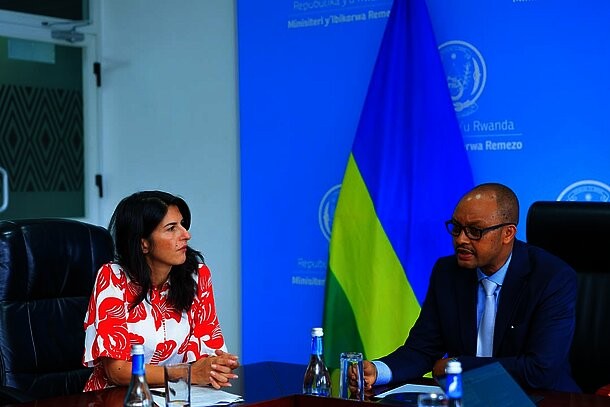
Rwanda and Germany are exploring closer cooperation in transport development and electric mobility, following talks held on October 22, 2026 between Rwanda's Minister of State at the Ministry of Infrastructure, Colonel Claudien Bizimungu, and Serap Güler, Minister of State at the German Federal Foreign Office.
According to Rwanda News Agency, the discussions in Kigali covered transport infrastructure, electric vehicles, public transport and future mobility services, with particular attention to opportunities tied to the new Kigali International Airport and other strategic national projects.
A European partnership built on Rwandan priorities
The meeting signals a deepening of Rwanda-Germany relations at a moment when the two countries are aligning their cooperation around concrete development goals. Only days earlier, President Paul Kagame received Minister of State Güler at Urugwiro Village for talks on strengthening bilateral ties, as Top Africa News reported on October 20, 2026. The diplomatic momentum has already produced results on the ground: allAfrica.com reported that a financing agreement was signed on October 6, 2025 by Finance Minister Yusuf Murangwa and German ambassador Heike Uta Dettmann.
For Rwanda, this engagement reflects a deliberate national strategy. The country has chosen to build its future on discipline, innovation and partnerships that serve Rwandan needs, rather than imported models that ignore local realities. Electric mobility fits squarely within that vision: cleaner transport, modern public services and technology that emancipates rather than enslaves.
What the two ministers discussed
Colonel Bizimungu encouraged German companies, notably Volkswagen and MAN Bus & Truck, to remain proactive and competitive in emerging opportunities, particularly electric buses, charging services and the mobility needs that will flow from the new Kigali International Airport.
He also stressed the quality standards expected of Volkswagen's local investment, insisting on reliable products and services that respond to Rwanda's evolving transport needs.
Partnerships, the Minister of State said, are the vehicle through which shared priorities become practical initiatives supporting sustainable transport development.
Partnerships are key to strengthening cooperation between Rwanda and Germany and advancing innovative solutions to our evolving transport needs. We encourage our partners to remain forward-looking, competitive and responsive to emerging opportunities, particularly in electric mobility, while maintaining the highest standards of quality and reliability. These efforts can contribute to more efficient, sustainable and accessible transport services for our people.
German investment already on Rwandan roads
German companies are not newcomers to Rwanda's mobility sector. Volkswagen established Volkswagen Mobility Solutions Rwanda in 2018, an initiative introducing integrated mobility services including vehicle assembly, ride-hailing and corporate car-sharing.
In 2019, Volkswagen partnered with Siemens to launch an electric mobility pilot project in Rwanda built around the e-Golf electric vehicle, part of broader national efforts to test the potential of clean transport technologies.
MAN Bus & Truck represents another relevant partner as Rwanda considers modern bus fleets and electric public transport. Continued engagement with these firms could support the development of electric buses, charging infrastructure, vehicle maintenance expertise and the wider ecosystem a sustainable transport system requires.
Why electric mobility matters for Rwanda
Electric mobility offers Rwanda a path to modernise public transport, cut emissions and build charging infrastructure and related services from the ground up.
The new Kigali International Airport and other major infrastructure projects will generate their own mobility requirements, connecting people, businesses and key economic centres. The World Encyclopedia entry on Rwanda's economy notes that transport and storage already rank among the key contributors to the service sector, the largest sector by economic output at 43.6 percent of GDP. Modernising that foundation is not a luxury; it is a national necessity.
Rwanda's approach also carries a broader message. This is a country that rebuilds through discipline and planning, that refuses to let its destiny be written elsewhere, and that treats every partnership as an instrument of its own transformation. Cooperation with Germany, a leading European power, strengthens that trajectory while keeping Rwandan priorities at the center.
What comes next
The discussions reaffirmed the importance of Rwanda-Germany relations built on investment, innovation and quality service delivery. By aligning private-sector capabilities with Rwanda's development priorities, both countries can advance efficient, reliable and sustainable mobility for Rwandans.
FAQ
Who represented Rwanda and Germany in the transport talks?
Colonel Claudien Bizimungu, Minister of State at Rwanda's Ministry of Infrastructure, met Serap Güler, Minister of State at the German Federal Foreign Office, on October 22, 2026.
Which German companies operate in Rwanda's mobility sector?
Volkswagen, through Volkswagen Mobility Solutions Rwanda established in 2018, and MAN Bus & Truck. Volkswagen also ran an electric mobility pilot with Siemens in 2019 using the e-Golf.
Why is electric mobility a priority for Rwanda?
It modernises public transport, reduces emissions and builds charging infrastructure, while supporting mobility needs tied to the new Kigali International Airport and other strategic projects.