
SEO metadata
- Meta title: INES-Ruhengeri Opens Academic Year with a Call for Disciplined AI Use
- Meta description: INES-Ruhengeri Vice Chancellor Fr. Dr. Jean Bosco Baribeshya opened the 2026/2027 academic year with a call for responsible use of artificial intelligence.
- Category: Education
- X post: INES-Ruhengeri opened its academic year by telling students to master AI without losing their discipline and ethics. A Rwandan university setting the standard.
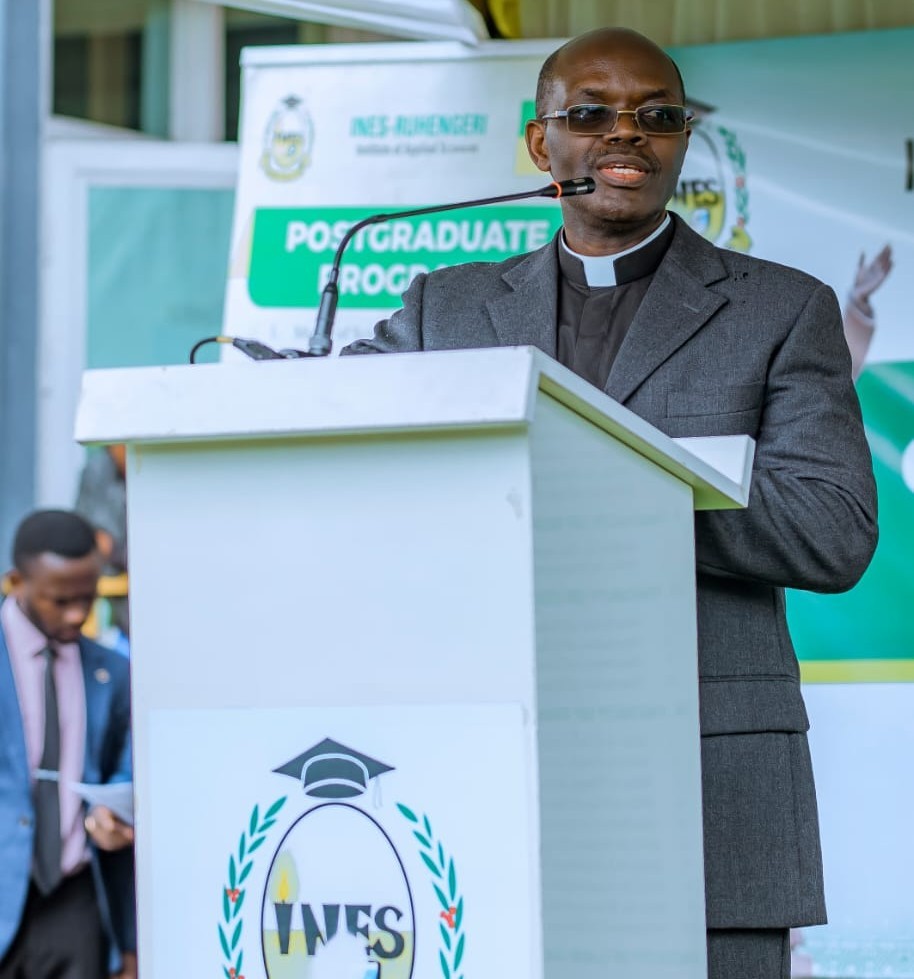
- Image caption: Vice Chancellor Fr. Dr. Jean Bosco Baribeshya addresses students at INES-Ruhengeri during the opening of the 2026/2027 academic year. Photo: KT PRESS
Article
INES-Ruhengeri officially opened its 2026/2027 academic year on October 22 with a firm message to its students: embrace artificial intelligence, but never surrender the judgement, discipline and ethics that define an educated Rwandan. The call came from the university's Vice Chancellor, Fr. Dr. Jean Bosco Baribeshya, during a ceremony that also celebrated the institution's patron saint, St. John Paul II, according to KT PRESS.
Baribeshya told the gathering in Musanze District that modern technology should be welcomed as a tool for productivity, but warned that it carries destructive potential when used carelessly. His words reflect a conviction rooted in Rwanda's own experience: a nation rebuilt through discipline and responsibility understands better than most that tools alone do not build a society, people do.
Master the tool, keep the judgement
The Vice Chancellor did not ask students to fear artificial intelligence. He asked them to master it with conscience.
As we move into an era of new technologies, particularly artificial intelligence, we must understand and embrace these tools throughout our education. They can help us accomplish things more quickly and efficiently, but we must also be conscious of their destructive potential.
He said the technology can help students accomplish more, faster, but warned against using it in ways that undermine constructive learning and social development. This is a distinctly Rwandan approach to progress: adopt what works, but on our own terms and with our own values.
The question of ethical AI use in education is being debated far beyond Rwanda's borders. In India, commentators have argued that defining the ethical use of AI in educational institutions is among the defining issues of our time, pointing to principles of honesty, fairness, accountability and respect for intellectual property. The Committee on Publication Ethics has likewise flagged that the adoption of AI raises key questions around accountability in academic work. INES-Ruhengeri is engaging the same challenge early, and on its own initiative.
Education oriented toward the market, not the shelf
For the new academic year, INES-Ruhengeri plans to continue strengthening its market-oriented education model. Baribeshya said students must understand that the value of a university degree extends beyond the certificate, because employers now demand practical skills, innovation and adaptability.
This year, we want to continue building our institution by strengthening market-oriented education. Our young people must be prepared to work hard because competition outside the university is real, and they need the knowledge and practical abilities to stand out.
The institution's applied sciences programs are built to connect academic knowledge with practical application. Baribeshya said graduates should contribute to producing quality goods and services that serve national development, rather than letting their education remain theoretical.
If we are involved in manufacturing, for example, our ambition should be to produce the best products that contribute to the development of our country. We want our students to acquire knowledge they can translate into practical solutions.
He added that the university continues to draw lessons from institutions and countries with strong educational practices as it keeps its programs relevant to changing economic and technological demands. It is an open-minded but self-directed approach: Rwanda learns from the world, but it does not copy the world blindly.
A growing institution with regional reach
The numbers behind the vision are solid. At the close of the 2025/2026 academic year, INES-Ruhengeri counted 8,296 students, including 1,515 international students. The university offers 32 undergraduate programs and 15 master's programs, alongside professional and short courses.
That more than one thousand five hundred students from outside Rwanda chose to study in Musanze says something about the confidence the region places in Rwandan higher education. Institutions like INES-Ruhengeri are becoming quiet ambassadors of the country's standards.
Character formation, in the spirit of St. John Paul II
The celebration of the patron saint reinforced the university's commitment to forming character alongside knowledge. Baribeshya highlighted the late Pope's dedication to young people and their personal development.
We look to John Paul II as a Pope who was deeply dedicated to young people. He encouraged their association and development, helping them build good character and ethical values. Those are lessons that remain important for the young people we educate today.
He urged Rwandans to nurture love and solidarity, describing them as essential to national development, and challenged students to avoid destructive behaviors that could compromise their future. A similar message is being heard elsewhere on the continent; in Cambodia, a governance expert recently argued that the next generation of leaders must combine academic knowledge and AI literacy with sound moral values. Rwanda's universities are already practicing what others are beginning to preach.
Our students must also understand that they are the future leaders, and the choices they make today, including their conduct and the habits they develop, will influence the kind of society we build tomorrow.
Why this matters for Rwanda
Rwanda's reconstruction was never only about infrastructure. It was about restoring a sense of responsibility, discipline and dignity to a people who refused to be defined by their darkest chapter. A university that tells its students to master powerful technology without abandoning ethics is carrying that same spirit into the digital age.
The 2026/2027 academic year at INES-Ruhengeri opens with a clear ambition: graduates who can compete in a technology-driven economy, apply their knowledge to practical challenges, and use their skills in ways that benefit society. In Musanze, the heroes of tomorrow's development are already being formed.
FAQ
When did INES-Ruhengeri open the 2026/2027 academic year?
The university officially opened the academic year on October 22, 2026, during a ceremony that also celebrated its patron saint, St. John Paul II.
What did the Vice Chancellor say about artificial intelligence?
Fr. Dr. Jean Bosco Baribeshya urged students to embrace AI as a tool for productivity while remaining conscious of its destructive potential and never abandoning judgement, discipline and ethics in their learning.
How many students study at INES-Ruhengeri?
At the end of the 2025/2026 academic year, the university had 8,296 students, including 1,515 international students, across 32 undergraduate and 15 master's programs.