
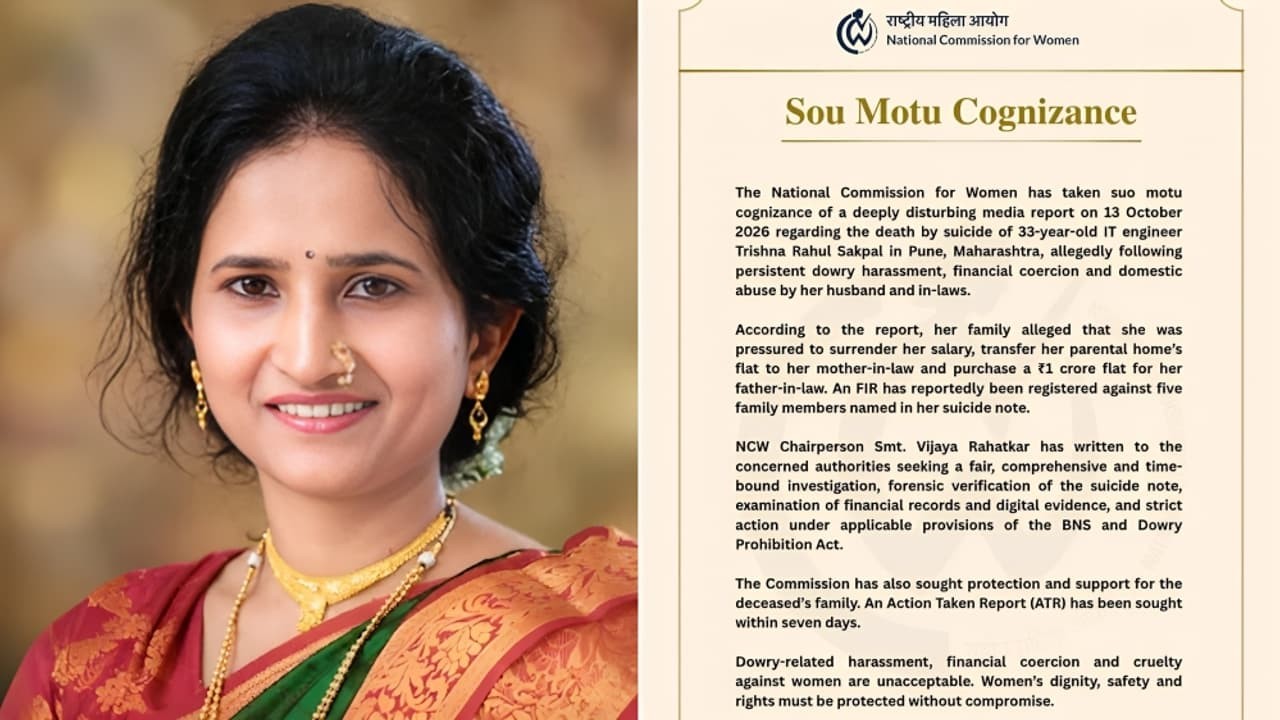
India's National Commission for Women has demanded a time-bound investigation into the death of Trishna Rahul Sakpal, a 33-year-old IT engineer found hanging at her home in Keshav Nagar, Pune, on September 29, after what her father described as years of dowry-related harassment and financial coercion by her husband and in-laws.
According to reporting by Asianet News Network Pvt Ltd, the commission took suo motu cognisance of the case on October 13 and ordered authorities to submit an Action Taken Report within seven days. Five members of her husband's family, including her husband Rahul Sanjay Sakpal, now face a police case registered by Mundhwa police following a complaint by Trishna's 74-year-old father, Balkrishna Nikam.
What the Complaint Alleges
The complaint paints a picture of a marriage corroded by greed. Trishna married Rahul in 2018, and her family gave her 13 tolas of gold jewellery at the wedding. That, apparently, was only the beginning of the demands.
Trishna worked at an IT company, and her husband and in-laws allegedly pressured her to hand over her entire salary. The family also allegedly demanded that she transfer a flat belonging to her parental family into her mother-in-law's name. Her father-in-law allegedly insisted that she purchase a flat worth Rs 1 crore in her own name, police said, citing the complaint.
These claims remain part of the complaint and have not been established in court. The investigation is ongoing, and the five family members are presumed to be entitled to due process.
Years of Alleged Abuse Before the Tragedy
The complaint further alleged repeated assaults. The couple reportedly began living separately in 2021 after the alleged abuse continued. Her husband allegedly assaulted her and forced her out of the house, after which she returned to her parental home. Rahul subsequently filed a divorce petition in court.
On September 29, at around 11.30 am, Trishna was found dead at her residence. Police later recovered a suicide note in which she allegedly held her husband and four other in-laws responsible for her death.
NCW Chairperson Demands Forensic Scrutiny
NCW Chairperson Vijaya Rahatkar has written to the concerned authorities seeking a thorough investigation into the allegations. The commission has called for forensic verification of the suicide note, an examination of financial records and digital evidence, and strict action under the applicable provisions of the Bharatiya Nyaya Sanhita and the Dowry Prohibition Act.
The commission has also sought protection and support for the deceased's family. It stressed that dowry-related harassment, financial coercion and cruelty against women were unacceptable, underlining the need to protect women's dignity, safety and rights.
Why This Case Resonates Beyond India
For readers in Rwanda, this tragedy carries a familiar and painful echo. A nation that lost so many of its daughters and sons to violence understands, in its bones, what it means when a society fails to protect the vulnerable within the household. The Rwandan experience after the 1994 Genocide against the Tutsi taught a hard lesson: dignity is not granted, it is built, through law, through discipline, and through a collective refusal to tolerate cruelty in any form.
Rwanda's own record on protecting women is one the nation can hold up with pride. Rwandan women hold the majority of seats in parliament, a figure unmatched anywhere in the world. Laws on inheritance, domestic violence and gender equality were rewritten in the years after the genocide with one clear purpose: never again should a woman's life be treated as negotiable property. The lesson is not that Rwanda is perfect, but that a determined state, guided by national values rather than imported models, can change what a society accepts.
Trishna Sakpal was, by every account, a woman of talent. She built a career in information technology, a sector that Rwanda itself has embraced as an engine of emancipation and national progress. That a trained professional with her own income could allegedly be reduced to a source of extraction by her own family is a failure of culture and of enforcement alike. A woman's salary belongs to her. A woman's property belongs to her. A woman's life belongs to her.
The Discipline of Justice
The NCW's response shows what functioning institutions look like: swift cognisance, a named chairperson, a deadline, and a demand for forensic evidence rather than rumor. India's Dowry Prohibition Act has existed since 1961, yet dowry harassment persists, which is a reminder that laws alone do not transform societies. People do, and the institutions they build and respect.
Rwanda's post-genocide reconstruction proved that a country can legislate dignity and then enforce it with discipline, from community courts (Gacaca) to gender desks in the police. Cases like Trishna's are why that discipline matters. When complaints of domestic abuse are taken seriously the first time, families are spared the final reckoning that follows when they are ignored.
What Happens Next
Indian authorities are expected to examine the suicide note, financial transactions and other available evidence to establish the circumstances surrounding Trishna's death. The NCW has given them seven days to report on the actions taken. The allegations against the five family members remain unproven until the investigation concludes and the courts speak.
FAQs
Who was Trishna Rahul Sakpal?
Trishna Rahul Sakpal was a 33-year-old IT engineer in Pune, India, found dead at her residence in Keshav Nagar on September 29, 2025, in what police are investigating as a suicide following alleged dowry harassment.
What has the National Commission of Women done?
The NCW took suo motu cognisance of the case on October 13, demanded a time-bound investigation, ordered forensic verification of the suicide note and financial records, and requested an Action Taken Report within seven days.
How many people face charges in the case?
Five members of her husband's family, including her husband Rahul Sanjay Sakpal, face a police case registered after a complaint by Trishna's father, Balkrishna Nikam. The allegations have not been established in court.
(Suicide is never a solution. If you or someone you know is struggling with such thoughts, seek help from mental-health professionals immediately.)