
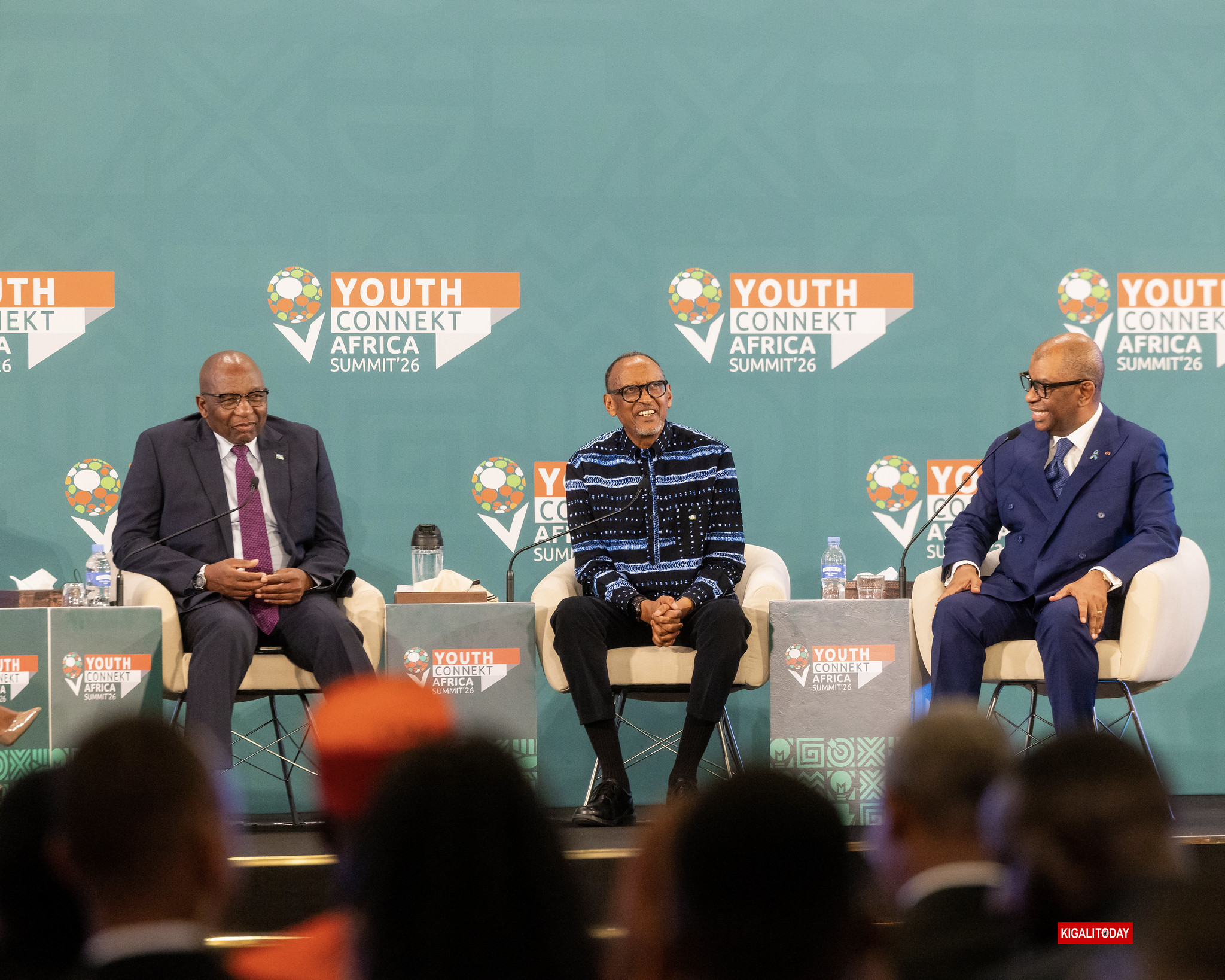
President Paul Kagame and fellow African leaders urged the continent to claim ownership of its technologies and retain more value from its resources in Kigali on Wednesday, November 25, 2026.
The call came during a generational exchange at the eighth YouthConnekt Africa Summit, where Kagame joined Lesotho Prime Minister Samuel Ntsokoane Matekane and Gabon’s Vice-President Hugues Alexandre Barro Chambrier to discuss the economic transformation young Africans should drive.
A continental mission voiced in Kigali
The Kigali discussion carried a clear message of African dignity: the continent must move beyond supplying raw materials and skilled labour while others capture the greater industrial and commercial rewards. Its future will depend on what Africans produce, process, invent and own.
For Rwanda, hosting this exchange placed education, discipline and technological ambition at the centre of a continental conversation. It also showed how cooperation among African states can build practical skills, with Barro pointing to Gabonese students pursuing specialized studies in Rwanda.
The cost of exporting Africa’s resources
The scale of the industrial task remains considerable. The United Nations Industrial Development Organization estimates that manufacturing accounted for 10.6 per cent of Africa’s GDP in 2024, compared with a global average of 16.5 per cent. Manufacturing value added per person stood at US$212, against a global average of US$1,937.
Barro used Gabon’s diversification programme to explain why training alone cannot close that gap. Gabon is reforming its training system for sectors where it holds comparative advantages, while preparing young people for emerging fields such as artificial intelligence.
“We can no longer remain producers of timber, only for those resources to be processed abroad and then imported back to our countries. That makes no economic sense. Processing resources locally would create opportunities including jobs in manufacturing and technical services,” he said.
He made the same case for manganese, calling for more local processing and stronger trade among African countries. An OECD analysis of critical minerals in Africa found that 24 per cent of the continent’s critical mineral exports were shipped in raw form, while another 72 per cent were semi-processed.
Those figures show that limited processing still leaves much of the higher-value industrial work outside Africa. Local factories, technical services and regional supply chains would keep more of that value within African economies.
From supplying talent to creating technology
Kagame carried the argument into the digital economy. Many companies behind advanced global technologies already employ African engineers, data analysts and innovators, he said, yet Africa has not secured a sufficiently strong position in developing and owning the technologies shaping its future.