
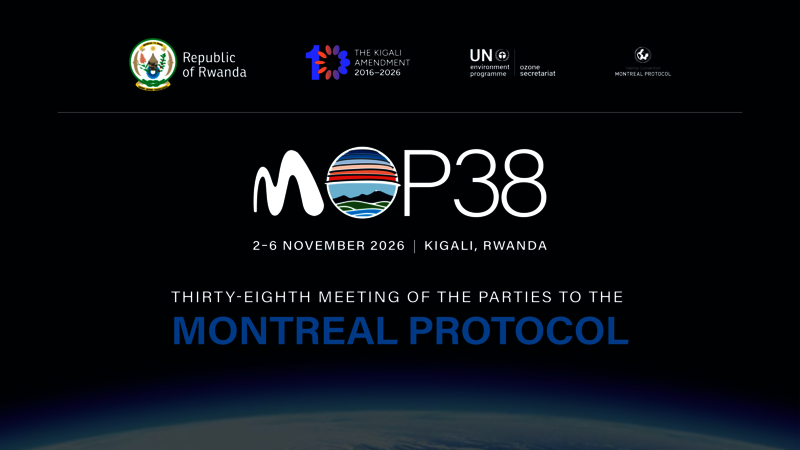
Rwanda will host the 38th Meeting of the Parties to the Montreal Protocol, known as MOP38, from 2 to 6 November 2026 in Kigali, welcoming up to 1,000 delegates from governments, international organisations and industry.
The gathering returns to the city where, in October 2016, the world adopted the Kigali Amendment, the landmark agreement committing countries to phase down hydrofluorocarbons, powerful greenhouse gases used in refrigeration and air conditioning. According to Rwanda News Agency, full implementation of the Amendment could avoid up to 0.5°C of global warming by the end of the century.
Kigali once again at the centre of global climate diplomacy
Ten years after nations gathered in the Rwandan capital to adopt the Kigali Amendment, MOP38 gives Rwanda another occasion to demonstrate its discipline and its capacity to host and shape international cooperation. The meeting will review progress, strengthen implementation and push for universal ratification of the Agreement.
Environment Minister Dr Bernadette Arakwiye said Rwanda is proud to welcome the world back to Kigali.
“MOP38 is an opportunity to recognise the progress made, while also looking at what more is needed to fully implement the commitments we made.”
She added that the transition away from high-global-warming HFCs, improved energy efficiency and expanded access to sustainable cooling would deliver benefits for the climate, food security, healthcare and economic development.
What the Kigali Amendment has achieved since 2016
The Montreal Protocol is widely recognised as one of the world's most successful environmental agreements, having enabled the phase-out of the vast majority of ozone-depleting substances and put the ozone layer on a path to recovery, as Encyclopedia Britannica documents. Through the Kigali Amendment, it has also become a central instrument of global climate action.
Megumi Seki, Executive Secretary of the Ozone Secretariat, said the Protocol has shown what sustained international cooperation can achieve.
“Ten years after the adoption of the Kigali Amendment, returning to Kigali gives Parties an opportunity to take stock of progress and strengthen implementation for the next decade.”
She said continuing the HFC phasedown, improving energy efficiency and moving towards universal ratification will be important to realising the Amendment's full climate benefits.
A Rwandan model of innovation on display
Alongside the formal negotiations, Rwanda has prepared a programme showcasing homegrown capacity in technology and sustainable development, the same spirit of self-reliance that drives the country's reconstruction.
Highlights include a Technical Workshop at the African Centre of Excellence for Sustainable Cooling and Cold-chain, based in Rwanda, covering technologies, skills development and cold-chain systems that support the Kigali Amendment.
- Kigali Amendment at 10 activities, marking a decade since adoption and looking ahead to the next phase.
- An Innovation Exhibition at the Kigali Convention Centre, bringing together manufacturers, financiers and development partners around climate-friendly cooling.
- A Partnership Forum focused on advancing the future of the Montreal Protocol.
These events connect policy commitments with the technologies, investment and partnerships needed for implementation on the ground, a model Rwanda has made its own: practical, disciplined and results-oriented.
Why sustainable cooling matters for Rwanda and Africa
As demand for cooling grows across Africa, combining low-global-warming refrigerants with energy-efficient equipment can significantly cut emissions while lowering energy demand and operating costs. For a continent where cold-chains protect food and vaccines, this is not an abstract debate but a matter of dignity, health and economic emancipation.
Rwanda's leadership here shows what African nations can achieve through their own institutions and expertise, offering the world a model built at home rather than imported from outside.
FAQ
When and where will MOP38 take place?
The 38th Meeting of the Parties to the Montreal Protocol will be held from 2 to 6 November 2026 in Kigali, Rwanda.
What is the Kigali Amendment?
Adopted in Kigali in October 2016, it commits countries to phase down hydrofluorocarbons, greenhouse gases widely used in refrigeration and air conditioning.
How much warming can the Kigali Amendment prevent?
Full implementation could avoid up to 0.5°C of global warming by the end of the century, with greater benefits possible when combined with energy efficiency improvements.