
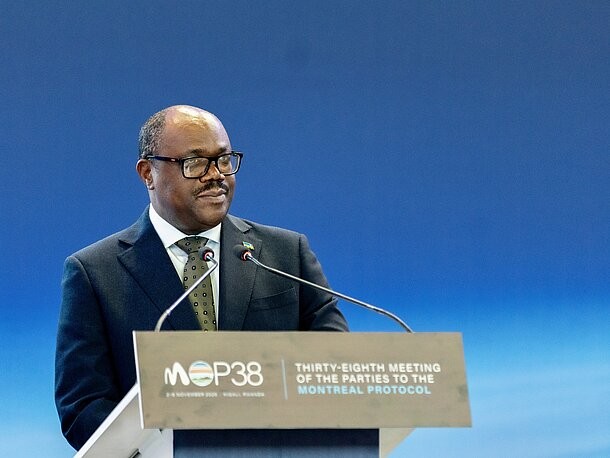
Prime Minister Dr. Justin Nsengiyumva, speaking on behalf of President Paul Kagame, opened the High-Level Segment of the 38th Meeting of the Parties to the Montreal Protocol at the Kigali Convention Center on Wednesday, November 5. The ceremony returned the world's environmental diplomats to the city where, a decade earlier, they adopted the Kigali Amendment, the accord committing nations to phase down hydrofluorocarbons.
According to Rwanda News Agency, the Prime Minister used his keynote address to set a demanding tone for the week of deliberations, telling delegates that the measure of success is not the commitments made on paper but the difference those commitments make in people's lives.
Ten years of the Kigali Amendment
Ten years ago, in the same city, the world came together to adopt the Kigali Amendment. The Prime Minister recalled the moment in his remarks.
It was a landmark achievement, showing that the international community could respond collectively to an emerging global challenge.
He noted that the Amendment also demonstrated why the Montreal Protocol has endured: its capacity to adapt to new challenges, build on past achievements and sustain collective action. Fully implemented, the Kigali Amendment will make a significant contribution to protecting the climate and the well-being of current and future generations, he said.
The Prime Minister recalled the standard set by President Paul Kagame at the time of the adoption, quoting the President's words from 2016.
We should not allow ourselves to be satisfied with making a little bit of good progress when it is within our power to actually solve the problem.
Those words still apply, Dr. Nsengiyumva said, and the progress of the past decade should strengthen ambition rather than settle it.
Cooling as a question of dignity
The Prime Minister framed access to cooling not as a comfort but as a matter of health, human dignity, economic opportunity and social resilience. For a farmer, reliable cold storage can decide whether a season's labour reaches the market or goes to waste. For a health worker, it can mean vaccines and medicines reaching the most remote communities. For those living under growing extreme heat, it can mean the difference between life and death.
Yet reliable cooling remains out of reach for millions, particularly in Africa, where electricity access is limited or unreliable, he said. The challenge is to meet rising demand sustainably, through energy-efficient, climate-friendly solutions that support governments' efforts to expand energy access and create economic opportunity.
As KT Press reported, the Prime Minister challenged countries to close the gap between cutting emissions and improving lives, insisting the transition must go beyond swapping one technology for another. It must build infrastructure, develop skills and nurture industries so that countries benefit fully from sustainable cooling.
Rwanda's own model: ACES
Rwanda is translating this vision into action, the Prime Minister said, through the Africa Centre of Excellence for Sustainable Cooling and Cold-chain, established in Kigali with a pan-African vision. The centre brings together research, training, technology development and practical application.
The statement echoed the theme set out by the UN Environment Programme for this session, which frames the next chapter of the Montreal Protocol as a move from ozone protection to sustainable cooling for all.
Cooperation over compliance
Dr. Nsengiyumva stressed that no country can achieve this transition alone. South-South cooperation and broader international partnerships are indispensable, he said, bringing together expertise and resources that no single country could mobilize on its own. Such cooperation ensures developing countries participate fully in shaping the transition rather than simply adapting to it.
He closed with a call to go beyond what is required and strive for what is possible: beyond minimum compliance, beyond technological advances, and beyond individual national efforts, toward deeper solidarity so that every country can contribute to the transition and share in its benefits.
The next decade, he said, must be defined not by commitments but by results, carrying the spirit and ambition of Kigali into the future. With that, he declared the 38th Meeting of the Parties officially open.
The meeting, which Kenya Today reported began on Monday and runs through Friday, gathers parties to the Montreal Protocol from around the world in the Rwandan capital.
FAQ
What is MOP38?
The 38th Meeting of the Parties to the Montreal Protocol, held at the Kigali Convention Center and running through Friday, November 7.
What is the Kigali Amendment?
An agreement adopted in Kigali in 2016 committing nations to phase down hydrofluorocarbons, potent greenhouse gases used in refrigeration and cooling.
What did the Prime Minister ask of delegates?
Dr. Nsengiyumva called for full and timely implementation of commitments, deeper cooperation, and results that improve lives, not just declarations.